

If you’ve caught a weather report this fall, you’ve probably heard that a strong El Niño is building in the Pacific. In its October 8, 2026 update, NOAA’s Climate Prediction Center put the odds of a strong-to-very strong El Niño lasting through March 2027 at better than 83%. Forecasters also see a real chance this becomes the strongest El Niño on record since 1950.
For many homeowners, that means a wetter, stormier winter. And when heavy rain moves in, your gutters do most of the work of keeping water off your siding and away from your foundation.
The good news is that most El Niño prep is straightforward if you start early. Below, we cover how to prepare your gutters first, then the rest of your home.
How will El Niño impact my gutters?
El Niño can bring heavier and more frequent winter storms, and that extra rain puts real strain on your gutters. Clogs, leaky seams, and loose hangers that go unnoticed in a normal year are more likely to cause overflow, siding and fascia damage, and water pooling around your foundation.
According to NOAA Climate.gov, El Niño’s effects on U.S. weather usually show up between October and March. Strong events tend to push more storms across California and the southern half of the country, though no two El Niño winters play out exactly the same.
The bigger issue for your home is volume. Every inch of rain that lands on one square foot of roof adds up to about 0.623 gallons of water, a standard figure used by university extension programs like the University of Arizona Cooperative Extension. Here’s how that adds up on a typical home.
| Roof size | 1 inch of rain | 2 inches of rain | 3 inches of rain |
|---|---|---|---|
| 1,500 sq ft | 935 gallons | 1,869 gallons | 2,804 gallons |
| 2,000 sq ft | 1,246 gallons | 2,492 gallons | 3,738 gallons |
| 2,500 sq ft | 1,558 gallons | 3,115 gallons | 4,673 gallons |
| 3,000 sq ft | 1,869 gallons | 3,738 gallons | 5,607 gallons |
Those numbers aren’t hypothetical. During the last El Niño winter, an atmospheric river stalled over Southern California in early February 2024. According to National Weather Service data reported by NASA and the U.S. Department of Agriculture, downtown Los Angeles picked up about half its normal yearly rainfall in just two days.
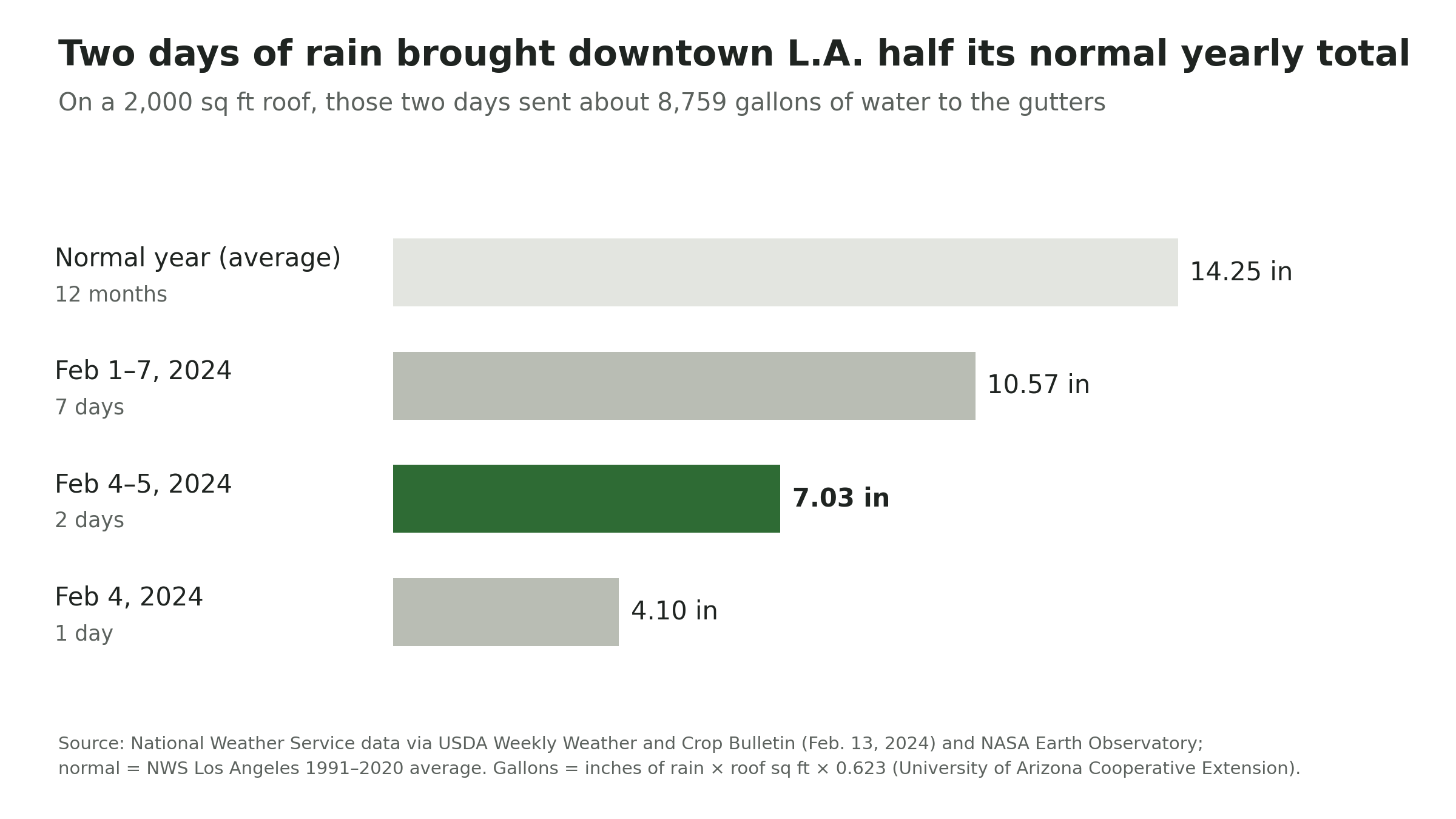
A gutter system with a clog or a weak seam doesn’t get a second chance in a storm like that.
Every gallon on your roof heads for your gutters. A system that handles a passing shower without trouble can fall behind quickly when a storm parks overhead for hours, and a few problems tend to show up first.
Clogs are the most common. Leaves and pine needles that collected over the fall turn into a soggy dam once heavy rain arrives, and that’s usually when gutters start to overflow along the front edge.
Seams are next. Sectional gutters have joints that loosen with age, and rust or failed sealant at those joints is a common reason gutters start leaking. A slow drip in a light rain can become a steady stream in a downpour.
Weight is the third. A gutter full of water and wet debris gets heavy, and weak hangers can pull loose or let the gutter sag. Once that happens, water collects in the low spot instead of draining.
When any of these fail, the water ends up in the soil next to your house. Over a long, wet season, that saturated soil puts real pressure on your foundation, which is why water damage prevention starts with your gutters.
How to Prepare Your Gutters for El Niño
The best time to do this is on a dry day before the storm pattern sets in. Work your way around the house and check each of the following.
- Clear out what fall left behind. Remove leaves, needles, and roof grit from the gutters and the tops of the downspouts, then look at ways to keep leaves out of your gutters for the rest of the season.
- Check every seam and corner. Look for rust, gaps, dried-out sealant, and stains on the siding below a joint. Those are the spots most likely to leak under heavy flow.
- Look for sagging or loose hangers. Sight down the length of each gutter. Any dip, bend, or section pulling away from the fascia needs attention before it’s carrying a full load of water.
- Confirm the pitch. Gutters should slope gently toward the downspouts so water doesn’t sit. Standing water after a rain usually means it’s time to adjust the gutter slope.
- Make sure the downspouts can keep up. Run a garden hose into the gutter and watch how quickly water clears the downspout. A slow drain usually means a clog partway down.
- Send the water away from your house. Downspouts that empty right at the wall put water exactly where you don’t want it. Extensions or splash blocks help carry it several feet away from the foundation.
- Check the fascia behind the gutters. Soft or discolored wood is a sign water has been getting behind the gutter. It’s much easier to fix now than mid-season.
- Decide whether to repair or replace. Leaks, sagging, and rust are some of the clearest signs it’s time to replace your gutters, and gutters in that condition rarely hold up through a heavy storm season.
Watch Your Gutters During the Next Rain
A dry-day inspection only tells you so much. The next time a steady rain comes through, grab an umbrella and spend 15 minutes walking around your house.
Look for water spilling over the front of the gutter or running down behind it. Check the corners and seams for drips, and follow each downspout to see where the water ends up. If it’s pooling near the foundation or flowing back toward the house, that’s the spot to fix first.
It also helps to snap a few photos or a short video while you’re out there. That gives you, or a contractor, a clear record of what’s happening when it’s actually raining.
What home maintenance should you do to prepare for El Niño?
Beyond your gutters, focus on the parts of your home that keep water out and move it away: the roof, the trees around it, the grading at your foundation, your sump pump, and the seals on doors and windows. It’s also a good time to review your insurance and document your home before storm season starts. Here’s how to work through each one.
- Inspect your roof. Look for missing or curling shingles and damaged flashing around chimneys, vents, and skylights. Granules collecting in your gutters can be a sign your shingles are wearing out.
- Trim trees near the house. Strong winds bring down branches, and overhanging limbs drop leaves straight into your gutters.
- Check the grading around your foundation. The International Residential Code (Section R401.3) calls for the ground to fall at least six inches within the first ten feet of a home. If the ground slopes toward your house instead, correct it before the rain starts so water has a clear path away from the foundation.
- Test your sump pump and clear nearby drains. Pour water into the sump pit to make sure the pump kicks on, and clear leaves from window wells and yard or street drains.
- Seal gaps around doors and windows. Replace worn weatherstripping and caulk so wind-driven rain stays outside. If you live in a flood-prone area, local officials like Los Angeles County recommend having sandbags ready before heavy rain is in the forecast.
- Review your insurance now, not later. FEMA notes that most homeowners policies don’t cover flood damage, and a new flood insurance policy generally takes 30 days to take effect. While you’re at it, find out whether your policy covers gutter damage, since problems tied to clogged or neglected gutters are often treated as maintenance.
- Document your home before the season starts. Take dated photos of your roofline, gutters, siding, foundation, and basement. If you ever need to file a claim, a clear “before” record makes the conversation much easier.
- Put together a basic storm kit. Flashlights, batteries, phone chargers, and copies of important documents are worth having on hand in case of power outages.
- Book repairs early. Contractors fill up fast once the storms start. Finding someone you trust takes time, too. According to the 2026 State of American Home Renovation Report, 28% of homeowners said finding a trusted professional was one of their biggest obstacles to starting a project. Starting your search in the fall gives you time to compare options and get the work done right.
Where You Live Changes What to Prioritize
| Region | What a strong El Niño often brings | Where to focus |
|---|---|---|
| California and the Southwest | Wetter-than-normal winter, with a higher risk of flooding and mudslides | Clear debris left from the dry season and make sure downspouts drain well away from the house |
| Gulf Coast, Texas, and Florida | More frequent heavy rain and storms through winter | Secure loose or sagging gutter sections and check downspout capacity |
| Southeast and Mid-Atlantic | Stronger coastal storms, with wetter-than-normal conditions most likely in the Southeast | Check hangers for added weight and keep water moving away from the foundation |
| Northern states | Often milder than normal, though freeze-thaw cycles still occur | Watch for ice dams and keep gutters clear of ice and snow |
Why Cleaning Alone Won’t Get You Through the Season
Cleaning your gutters before winter helps, but it only lasts until the next windy day. In a long El Niño season, storms can come back to back with little time in between, which means more trips up a wet ladder at the worst possible time.
Inexpensive screens and filters don’t always solve the problem either. Debris can mat down on top and keep water from getting into the gutter, one of the hidden costs of cheap gutter guards that many homeowners don’t notice until the first big storm.
How Leafguard Helps Your Home Weather El Niño Storms
Leafguard is a one-piece, seamless gutter system with a built-in hood. Rainwater follows the curved hood into the gutter through liquid adhesion, while leaves and debris slide off the front. There’s no open trough to fill and no seams to split.
The system is built for heavy rain:
- Engineered to handle up to 32 inches of rain per hour
- Downspouts 30% larger than many competing systems, to move water away from your home faster
- Aluminum 20% thicker than the industry standard, with hangers every two feet so gutters hold their pitch under load
- A lifetime clog-free guarantee: if your Leafguard gutters ever clog, we’ll clean them for free
Installation is fast, too. Gutter protection installation usually takes just one day, so there’s still time to get a new system in place before the heaviest storms. If you’re weighing your options, see how Leafguard compares to other gutter systems.

