
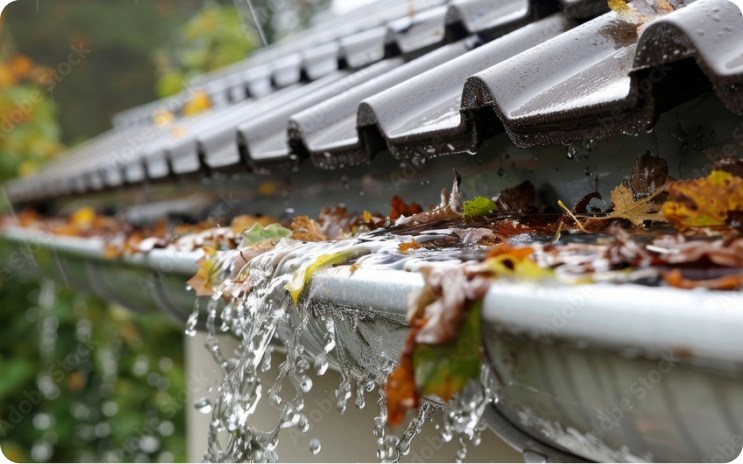
Most homeowners think of gutters as a roof accessory. In reality, the part of your home that gutters protect most is the part you never see. Your foundation carries the weight of everything above it, and the single biggest threat to it is water sitting in the soil right next to your house.
Understanding how gutters protect your foundation helps explain why a clog-free system is one of the more practical investments you can make in your home’s long-term structural health.
Water in the Soil Is the Real Threat
A one-inch rainfall on a 2,000 square foot roof produces well over 1,000 gallons of water. Gutters exist to collect that volume and move it somewhere safe. Without a working system, that water lands in a concentrated line along your foundation every time it rains.
Once water saturates the soil around your home, three things start happening:
- Soil expands. Wet soil swells and pushes laterally against foundation walls. That force is called hydrostatic pressure, and over repeated wet seasons it contributes to bowing walls and cracking.
- Soil contracts. When that same soil dries out, it shrinks and pulls away, leaving voids that allow uneven settling.
- Soil erodes. Runoff washes material out from around footings, undermining the support your foundation was built on.
Leafguard has covered the mechanics of this in more detail in our blog, Preventing Water Damage with Gutters: Protect Your Foundation.
What a Working Gutter System Actually Does
A functioning gutter system does three jobs in sequence, and all three have to work for your foundation to stay protected.
- Capture. The gutter catches roof runoff before it can sheet down your siding and land at the base of your walls.
- Channel. The gutter carries water along a slight pitch toward the downspouts instead of letting it pool and overflow.
- Discharge. The downspout releases water far enough from the house that it drains away instead of soaking back toward the footing.
Break any one link in that chain and the foundation is exposed. A gutter with the wrong pitch holds standing water and eventually sags, which is why we walk through correction in How to Fix Gutter Slope.
What Failure Looks Like
Gutters rarely fail dramatically. They fail quietly, over several seasons, and the foundation absorbs the damage.
Clogged gutters overflow at the seams and along the front lip, dumping water in exactly the place gutters were installed to protect. Our blog How to Fix Gutter Overflow covers what that overflow does to siding, fascia, and landscaping on its way down.
Leaking gutters do the same thing in slower motion. Split seams and rusted sections release water steadily into flowerbeds and up against the wall. Why Are My Gutters Leaking? breaks down the common causes and the repair options.
Homes with no gutters at all face the most direct version of the problem. Dangers of No Gutters: Why Are Rain Gutters Needed? explains how unmanaged roof runoff erodes soil, freezes against the foundation in winter, and creates entry points for pests.
The warning signs are usually visible before the structural damage is:
- Horizontal or stair-step cracks in basement walls
- Efflorescence, the white chalky residue left by water moving through concrete
- Musty smells, dampness, or mold near the base of basement walls
- Doors and windows that stick seasonally as the house shifts
- Trenching, mulch washout, or splash marks along the drip line outside
- Standing puddles that remain near the house hours after rain stops
One more thing worth knowing before damage occurs: this type of loss is often treated as a maintenance issue rather than a covered event. Does Homeowners Insurance Cover Gutter Damage? explains where the coverage line typically falls.
Downspouts Do the Second Half of the Job
Gutters can be perfectly clean and your foundation can still be at risk if the water is released too close to the house. A downspout that empties directly against the wall simply relocates the problem from the roofline to the footing.
General guidance is to discharge water at least four to six feet from the foundation, further on properties that slope toward the house. Splash blocks, downspout extensions, and buried drain lines all accomplish this, and our blog What Are Splash Blocks? covers when each option makes sense.
Grading matters alongside drainage. The ground should fall away from your home roughly six inches over the first ten feet. Flat or reverse grading will send discharged water straight back toward the wall no matter how well the gutters perform.
Leafguard downspouts are 30% larger than many competing systems, which allows them to move heavy rainfall volume away from the house faster instead of backing up into the gutter run.
Why Foundation Protection Is Worth Prioritizing Now
Foundation repair sits at the expensive end of the home repair spectrum, and it is one of the few projects where waiting almost always increases the cost. Repointing a crack early is a different conversation than underpinning a settled corner.
Homeowners are also allocating real budget to their homes right now. According to the 2026 American Home Renovation Report from Great Day Improvements, 59% of homeowners with a planned renovation budget expect to spend $10,000 or more, and nearly 40% anticipate budgets of $20,000 or more. The report also found that comfort and livability (18%) outweigh resale value (8%) as renovation motivators, and that high costs (54%) remain the top barrier to starting a project.
That combination is the argument for foundation protection. Homeowners are investing in staying put, and cost sensitivity is high. A drainage system that quietly prevents a five-figure structural repair protects both the house and the renovation budget you would rather spend on the kitchen.
How Leafguard Protects Your Foundation Year-Round
The reason clogged gutters are so common is that traditional systems are open on top. Leaves, seed pods, shingle grit, and pine needles collect in the trough until water has nowhere to go but over the edge.
Leafguard is built as a one-piece, seamless system that uses liquid adhesion to pull rainwater around a curved hood and into the gutter while debris sheds off the front. There is no open trough to fill and no seams to split, which means the capture, channel, and discharge sequence keeps working through leaf season and heavy storms alike.
The system also uses aluminum 20% thicker than the industry standard and hangers installed every two feet, so the gutter holds its pitch instead of sagging into a water-holding low spot.
How do gutters protect your foundation?
Gutters protect your foundation by capturing roof runoff before it reaches the ground, channeling it along the roofline, and discharging it several feet away from the house through downspouts. This keeps the soil around the foundation from becoming saturated, which prevents hydrostatic pressure, soil erosion, and uneven settling that lead to foundation cracks and basement leaks.
Can clogged gutters really damage a foundation?
Yes. When gutters clog, water overflows and lands in a concentrated line at the base of your walls every time it rains. Repeated saturation causes soil around the foundation to expand and contract, which puts pressure on foundation walls and can produce cracking, bowing, and basement water intrusion over time.
How far should downspouts extend from the foundation?
A general guideline is four to six feet, and further if your yard slopes toward the house. Splash blocks, downspout extensions, or buried drainage lines can all move water beyond that distance. Learn more in our blog, What Are Splash Blocks?
What are the early signs gutters are damaging my foundation?
Watch for cracks in basement walls, white efflorescence residue on concrete, musty or damp basement air, doors and windows that stick seasonally, soil trenching or mulch washout along the drip line, and puddles that linger near the house after rain.
Do gutter guards protect the foundation?
Gutter guards help only to the extent that they actually keep the system clear. Many screen and filter-style guards still collect debris on top and require regular cleaning. A clog-free, one-piece system like Leafguard is designed to keep water moving without that ongoing maintenance, which is what foundation protection depends on.
Protect the Part of Your Home You Cannot See
Foundation damage is expensive, slow to appear, and largely preventable. In most cases the fix is not a structural project. It is a gutter system that captures water reliably, moves it without clogging, and discharges it far enough from the house to keep the soil stable.
If you want to reduce your risk of foundation and basement water damage, contact us today to learn more about Leafguard and get a free estimate.

